After a really comfy night’s sleep we took a lazy approach to getting up, making it into town for breakfast by about 9am or so. The Silly goat, the most recommended café in town – by Trip advisor and at least three people who had visited or lived in Broken Hill, is closed on Monday and only open for takeaway on Tuesday so we had to explore a different option. The Al Fresco Café, attached to one of the many hotels in the main street was next on the Trip Advisor list so we thought we’d give it a go. It was a pleasant morning so we sat outside – I had the big brekky – a traditional mix of eggs, bacon, tomato, mushrooms, sausages and toast. White toast. With butter. And a solid plain beef sausage – the perfect combination for a simple brekky. Dan had the eggs benny with bacon – again a solid benedict with a good solid hollandaise.
After breakfast we took a stroll along the main street and the first thing that strikes you – apart from the number of pubs is the fact that most of them (and the other buildings) have retained their early 20th century awnings and verandas. Aside from that the street is peppered with old sandstone buildings from the town’s heyday much like most of the larger towns in Western NSW. There is also a particularly lovely building where the shopfronts have retained their art deco style doors and curved display windows. Maybe because of renovations or because of COVID, both the shopfronts were empty. One hopes this is just a temporary situation as it would be a real tragedy to see this building fall into disrepair. As we walked further up the main street, Argent Street, the derelict buildings and boarded up shops started to outnumber the open ones and the houses surrounding them had security screens. It was a very stark contrast to the other end of the street. The other interesting phenomenon was the handrails to step down from the extraordinarily high gutters. Between the handrails and the massive culverts all over town designed to funnel water off the roads or in some cases onto them to protect properties, it is clear flooding is a thing in Broken Hill.
Our walk wouldn’t be complete unless Dan tried to find a model shop. The Electronics and Hobbies store turned out to be more electronics than hobbies. No model kits, just some Warhammer stuff. But Dan did purchase some kind of adapter or something for one of the plethora of electronic gizmos he brought with him – Something about a card reader for his camera, I think.
Our next stop was the miner’s memorial high atop the town. The impressive building which looked like it housed a massive function centre is actually just a small café and gift shop. The miner’s museum a hundred metres or so from the main building consists of a wall of names of those who lost their lives in local mines. E most confronting part is that the majority of them died in the first 20 or 30 years of the mine opening. Rock falls, other types of falls and being crushed by mining equipment. The good news is that there have been way less deaths in the last 30 years, including plenty of years without fatalities. The most common cause of death is now heart attack. It is unclear whether any of these were actually related to mining activity or whether they are counted because they had a heart attack while working. The top of the rubble pile has little besides the memorial and café and a few pieces of old machinery that are collected there but not properly formed as a collection. It also has Broken Hill’s big thing. Well actually the oversized park bench that looks like something out of a fairy tale is actually a sculpture by a local artists positioned to take advantage of the view over the town with the all-important rail yards in the foreground. This is one place where the freight or mining product is seemingly moved by rail. Broken Hill is also on the Indo Pacific passenger train route – a luxury trip these days that takes passengers from Sydney to Perth across the Nullarbor. [Try this at Home – Frank Turner – While friends had raved about Frank turner for a while, it was him being on the bill for a Newcastle show supporting the Dropkick Murphys that made me buy this album. A road trip with Dan and my brother, we listened to it on the way (once we had played a suitable number of dropkick songs of course) and were all converted.]
I am a keen follower of the work of ex-Canberra stencil artist Luke Cornish – otherwise known as E.L.K. He had done a road trip to Broken Hill in recent trips so to make things fun, just like we hunted for Banksys in Bristol we decided to search for E.L.K works in and around Broken Hill. The first of these was to be found in Broken Hill’s Crystal Lane – the back Alley that runs parallel to Broken Hill’s main street and home to many of its pubs – Argent Street.
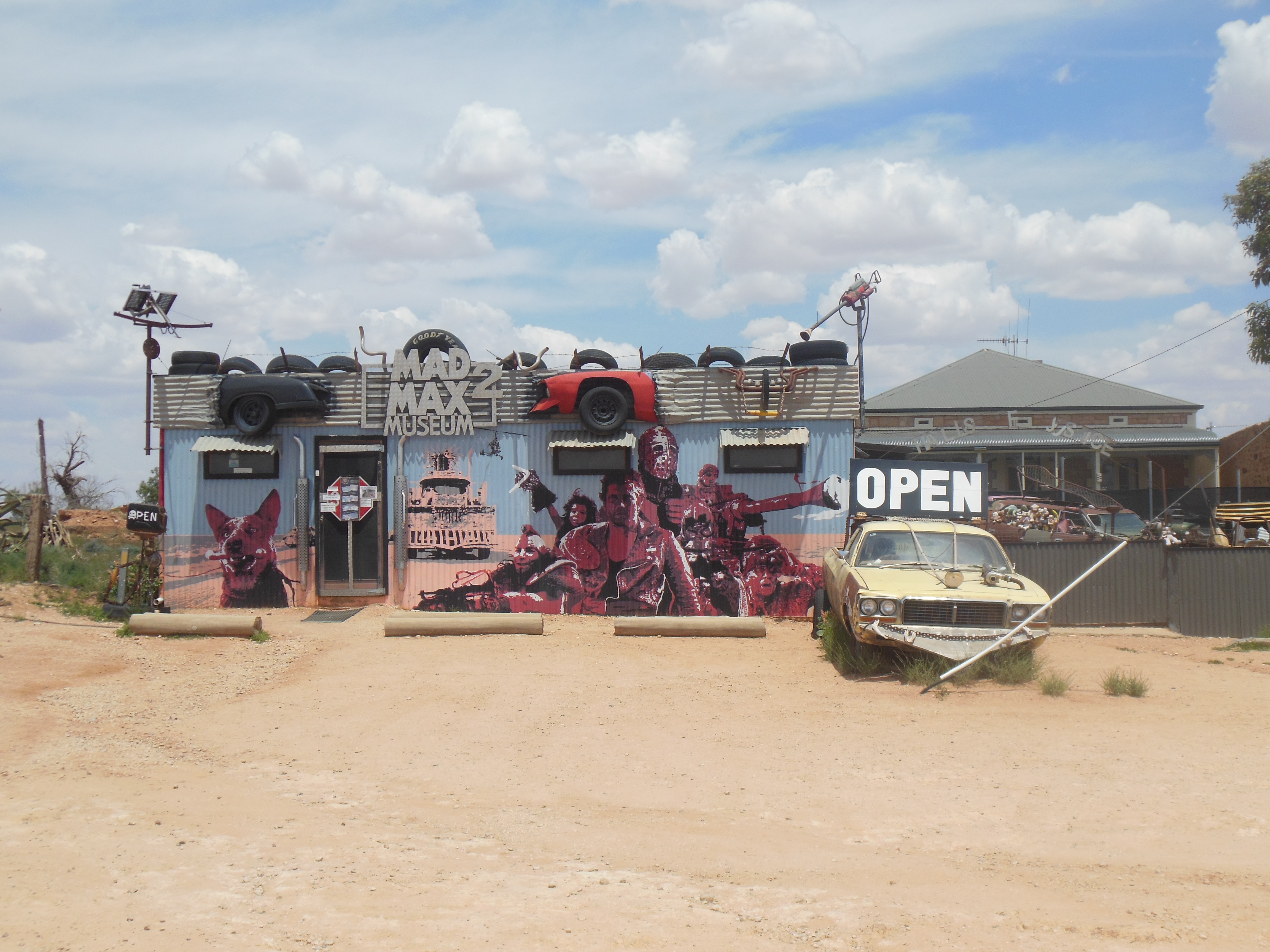
After a short detour back to our hotel to shuffle rooms – due to our last-minute decision to arrive a day earlier due to the Lake mungo closure – we headed out to the deserted mining town of Silverton. A thriving metropolis in its heyday when silver was discovered here in the 1850s, Silverton is a shadow of its former self with a population of just 40 plus a couple of donkeys. What Silverton has done due to a handful of its historic buildings still standing in their original form, is reinvent itself as a film location. Starting with Mad Max 2 which was filmed in and around Silverton in 1982. The pub too has been the star of a number of movies 9ncluding A Town Like Alice, Razorback, The Craic and Dirty Deeds. But let’s get back to the main reason for our visit here – The Mad Max 2 museum. Not the Mad Max museum, the Mad Max 2 museum. Because it was filmed here. Alongside the thousands of photos taken on the shoot, the museum houses some interesting paraphernalia from original costumes to many, many replicas of the vehicles, including the interceptor. They were bits and pieces of some stunt double cars and some broader studies of actors who played bit parts in the film. There was also some paraphernalia from other films, like the most recent one shot in Tunisia. Apparently because it was too green out here the past couple of years. The museum is basically housed in a shed (with aircon) with an annexe on dirt under corrugate. Every spare space was covered with photos or posters, like the one calling for extras for the shoot, with (mostly) handwritten signs. There are two cylinders in the middle of one section with a costume from the newest film and what I assume to be a replica costume from Mad Max 2 – complete with customised leather jacket – couldn’t make out if it was originally a stag or one of the ones Joey Ramone used to wear. There were also dog food tins from the infamous scene in the film and weirdly a trophy from the set of the Fury Road movie that was passed around the crew member of the week with something added to it each time. For a museum that is specifically dedicated to the second film in this franchise, there is quite a bit of paraphernalia from the latest instalment. I guess at least it shows the regard of the filmmakers for this little museum in a tin shed in the middle of nowhere. And outside there were cars from the film including the snake car, the gyrocopter and (quite a few) replicas of the interceptor. There was also some of the movie merch including the clay statue of the interceptor I have at home. The museum was worth a look and like most museums set up by uber fans was an eclectic collection that was assembled to share the experience with other uber fans and prove a curiosity to bystanders.
Our plan was to spend the afternoon in Silverton, have an early dinner at the pub and then head out to Mundi Mundi lookout to see the sunset so we looked around for something to do. The Silverton Gaol museum took our fancy – we expected it to be a museum about the gaol, the characters housed there and the history of policing the mining town of Silverton. Instead, there was some history of policing – Australia’s first terrorist attack took place in Broken Hill in 1915 involving two former camel drivers, an ice cream cart and an attack on a train that killed four people. This was captured amongst the thousand of artefacts, pictures and articles in the museum but mostly this like so many similar collections around Australia was a history of day to day life – from silver trophies to bridal outfits to cutlery and glassware to washing machines. While these artefacts are interesting. For us probably not as interesting as others. Dan’s family have bought and sold these kinds of artefacts for years and their home is filled with some of the more impressive pieces. As for me, I spent many a holiday on the family farm, itself settled in the 1850s, trawling through the mounds of junk that had just been left to rust about the place. That’s the thing about family farms that have passed down through generations of those who came from Ireland with nothing, built a life on the farm and worked the place through two wars and the great depression – they become havens of hoarding where nothing is ever thrown away because it might prove useful one day. While I wasn’t surprised to see things in this museum that were still used on the farm during my lifetime, I was disturbed by one of the historical displays which featured paper $1 and $2 notes (replaced by coins in the 1980s – the reason I remember this is because in the grand tradition of ridiculous jewellery from the 80s like toothbrush ends as earrings, my dad had made me earrings out of $1 coins when they were released.
After the Gaol museum, we contemplated going on a Daydream mine tour, which takes you underground in an old silver mine. It appeared like they were still open but we baulked at the $32 per person cost for the hour and a half tour and opted to drive back to Broken hill to visit the Outback sculpture symposium. We drove out to the symposium and decided to take the scenic walk to it. We turned back about 20 minutes into the hour long trek as the sun was beating down and it was unbearably hot. We had no water with us. If you decide to take this walk, choose to do it in winter or at dawn, not at 2pm on a 36 degree day. We took the easy route and drove up to the sculpture garden. There were some interesting sculptures – the most striking being the oft photographed Inca style head. The sculptures are all carved from the local sandstone but unfortunately the harsh climate out here – the sun, the wind and occasional rain has had a similar effect on the sculptures as provides its beauty in landscape – its transitory nature. Some of the sculptures had suffered more from the erosion of time than others and I wondered whether the sculptors had considered that in their design or whether indeed the style, particularly those inspired by ancient cultures, indigenous Australian or otherwise, inherently protected them against the ravages of time.
After our sculptural sojourn, we headed back to Silverton to while away the afternoon at the pub (which isn’t the easiest thing to do when you are trying to avoid drinking too much so you can drive). The pub itself is just what you’d expect an outback pub to be, probably why it has featured in so many movies and beer ads. You enter the sandstone building through a pair of double doors that open into a bar that in normal times you would expect to see filled with patrons huddled around the bar. But alas these are not normal times and with standing or sitting at the bar to drink banned under COVID-19 restrictions, it was off to the extensive beer garden that we headed with a coldie. While the outdoor area was shaded, the great Aussie salute was a necessary skill to ward off outback Australia’s large fly population. I have to say, of all our pub experiences, the food at Silverton Pub was the most underwhelming. We ordered some nachos to have with our beers. Basically a few corn chips with some tasteless salsa drowned in cheese. Apart from the flies and the heat – the beer garden was pleasant enough – a large space with sizeable communal round tables and a stage made from the back of a no longer functioning old truck. You imagine swells with backpackers and other travellers and local revellers in different times. Despite the disappointing nachos, we were sort of committed to the sunset at Mundi Mundi so had no choice but to persevere with dinner. When we ordered we discovered where all the other pub guests had been sitting – there was an enclosed area, free of flies, with ceiling fans to cool things down a bit. It was quite pleasant in there. I should’ve played it safe and got a schnitzel or a steak but couldn’t go past the rissoles with gravy – a childhood favourite. I am often disappointed when I order rissoles – except for one time at the Dalgety pub. (Subsequent visits there have also disappointed.) The Silverton pub rissoles were also a disappointment – firstly rissoles should have flavour beyond ground beef with a high fat content – mine have chopped onion in the mix. Secondly the gravy came with more fried onion than gravy – I guess an attempt to drown the flavourless rissoles. And the mashed potato had no flavouring. This is the country people – where is the butter? Even pepper and salt could save this mash. Dan had a hot dog that tasted like a sausage and an average pie and chips. The saving grace was the quite tasty bread and butter pudding. [Waiting for the Great Leap forwards – Billy Bragg – there is no time that is bad for Billy Bragg but the trip west had put us in a singer songwriter vibe and Worker’s Playtime seemed an appropriate album. I can’t even remember how I got into Billy Bragg but I do recall it was way back and probably started with Sexuality, closely followed by this track.]
After dinner we headed out to Mundi Mundi lookout where we expected to be the only ones there but it is a popular spot and at least four or five groups had pulled up to do exactly as we were – watch the sun set across a vast plain so flat that you could almost see the curvature of the earth, or at least the illusion that it curved. After joining others taking the obligatory middle of the deserted road shot, we settled in to watch a glorious sunset. Two girls next to us had parked reverse with their massive four-wheel drive ute and were sitting in the train enjoying a picnic. Others were just sitting in their cars waiting for the sun to start dropping and the flies to disappear. I hadn’t ever thought much about it but flies do disappear when the sun goes down and while there are some mozzies out here, it is so dry you don’t fins that many. The recent rains though have meant that the bug population across southern Australia, including outback NSW has markedly increased this spring. We sat and enjoyed the magnificent show mother nature puts on every evening. The photos of sunsets, no matter how great, never seem to capture the immense beauty or indeed the sensory experience of a sunset. Despite the gathering and the chatter, there is something of the silence in the landscape when the sun falls that can only be experienced out in it and which seems so much more vast out here.
Once the sun went down, we headed back to our hotel for an early night so we could rise to see the dawn over Menindee Lakes.


